This page is not a listings feed. It is the context you want before you open one: what kind of inventory actually shows up in Cotswold, roughly how it is priced, how quickly it tends to move, and what a listing description is usually signaling. For current listings, work with a local buyer's agent who can pull real-time inventory from the MLS.
What actually comes to market here
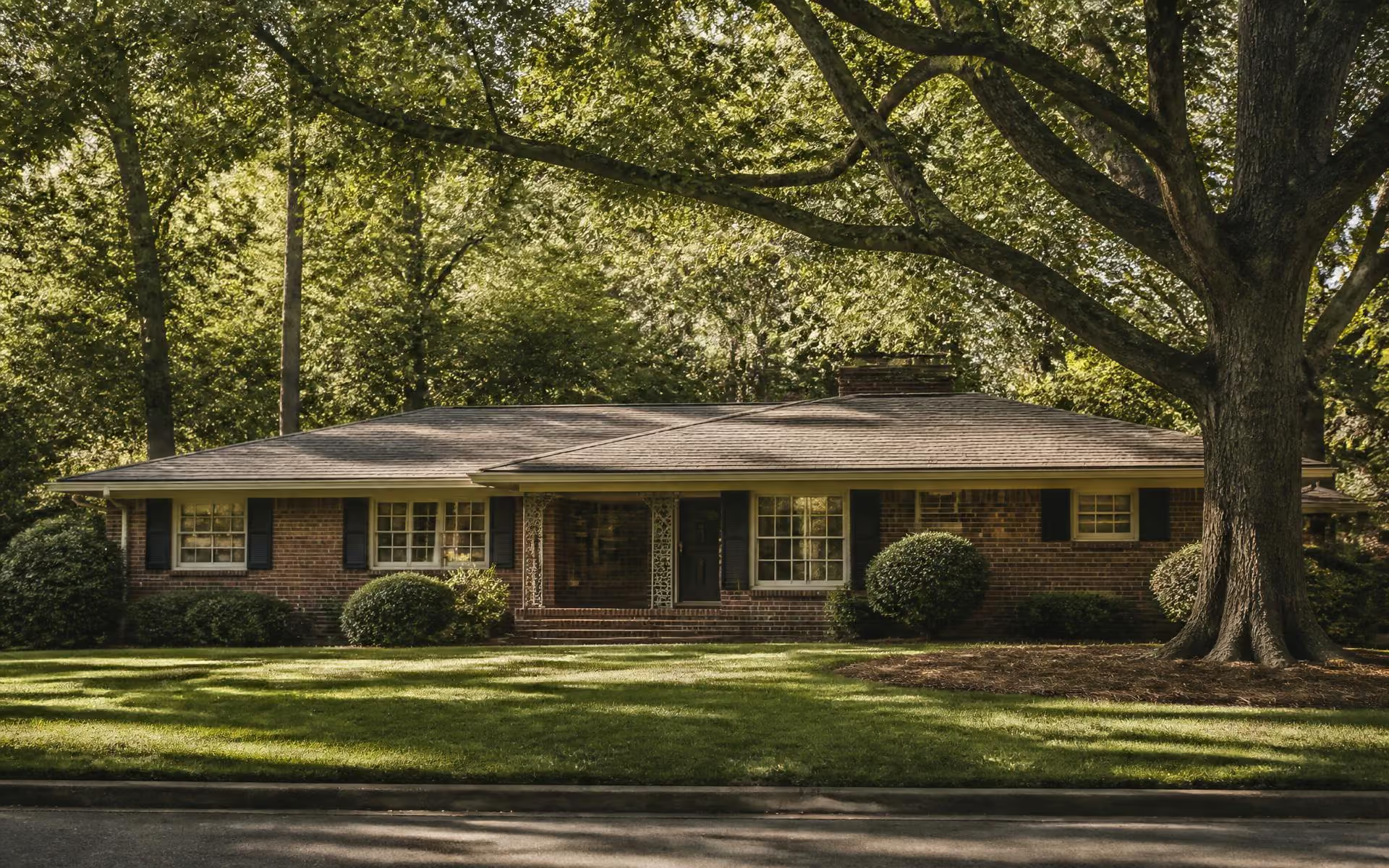
Cotswold's housing stock is dominated by brick ranches and split-levels built in the 1950s and 1960s, with pockets of colonials and a small but growing amount of new construction on teardown lots. See Cotswold architecture for the styles in more detail. Because the neighborhood was built out over a relatively short window, most of what comes up for sale falls into one of three buckets: largely original homes, homes with a past partial update (kitchen or baths, sometimes both), and homes that have gone through a full renovation or rebuild.
Inventory is not evenly distributed. Streets closer to Cotswold Village Shops and the quieter interior — including pockets near Sherwood Forest, Oakhurst, and Sardis Woods — tend to generate more competition when a home does list, simply because walkability and lot quality are harder to replace than square footage.
Price bands, in editorial terms
We deliberately avoid quoting specific price figures on this page, because they age quickly and vary block by block. As a general shape: original-condition homes on smaller lots sit at the lower end of the local range, moderately updated homes in the middle, and fully renovated or newly built homes at the top. The spread between the bottom and top of that range in Cotswold is wide — wider than in a subdivision built all at once — because the underlying bones vary so much from house to house. For an actual number on a specific street, ask an agent to run recent closed comparables rather than relying on an automated estimate.
Days on market and seasonality
Like most of Charlotte, Cotswold tends to see more new listings and more buyer activity in spring and early fall, with a slower stretch around the winter holidays. Homes that are priced realistically and show well near the Village or on desirable interior streets often go under contract within the first couple of weeks on market. Homes that need work, or that sit directly on Randolph Road, Monroe Road, or another busy arterial, typically take longer and see more price sensitivity from buyers. None of this is a guarantee for any individual home — always check a current market report from the Canopy Realtor Association for the latest pace.
Off-market and pre-market activity
Because Cotswold is a small, well-established neighborhood with long-tenured owners, some transactions happen quietly — a homeowner mentions to a neighbor or a longtime local agent that they are thinking of selling before anything is listed publicly. This is more common for larger lots or unusually desirable streets. If you are house-hunting only through public search portals, you are likely missing a slice of what actually trades here. Working with an agent who has deep, ongoing relationships in the neighborhood — not just a general Charlotte book of business — is the practical way to see more of the real inventory.
How to read a Cotswold listing description
- "Updated" versus "renovated." "Updated" often means cosmetic work — paint, fixtures, maybe a kitchen refresh. "Renovated" should mean structural or systems-level work. Ask for permit records either way.
- Lot language. Terms like "level lot" or "private backyard" are doing real work in a neighborhood where topography and tree canopy vary block to block. Verify against a parcel map, not just photos.
- School references. Listing agents sometimes describe school assignment loosely. Confirm current CMS assignment directly — see Cotswold schools — rather than trusting the listing copy.
- "Walk to the Village." True for a meaningful share of Cotswold streets, but distance and sidewalk continuity vary. Cross-reference with our walkability guide.
Costs beyond the purchase price
Before making an offer, factor in property taxes (see our property tax guide), likely near-term maintenance given the age of most homes, and insurance costs, which can vary with roof age and electrical/plumbing systems. Buyers moving from out of state sometimes underestimate the combined effect of these carrying costs — our cost of living page walks through that math in more detail.
New construction and teardown activity
A small but visible share of Cotswold sales each year are older homes purchased for teardown-and-rebuild, particularly on larger or better-oriented lots. If that is your plan rather than buying a move-in-ready home, see new construction in Cotswold and custom home building for what that process typically involves, including zoning and permitting considerations from the city's Unified Development Ordinance.
Working with representation
Whatever your budget or timeline, a buyer's agent who works Cotswold regularly will know which streets tend to flood or sit close to commercial traffic, which HOAs or informal neighborhood associations are active, and which homes are quietly about to list. That local texture rarely shows up in an online listing, and it is the main reason to work with someone who specializes in this specific pocket of south Charlotte rather than the city broadly.