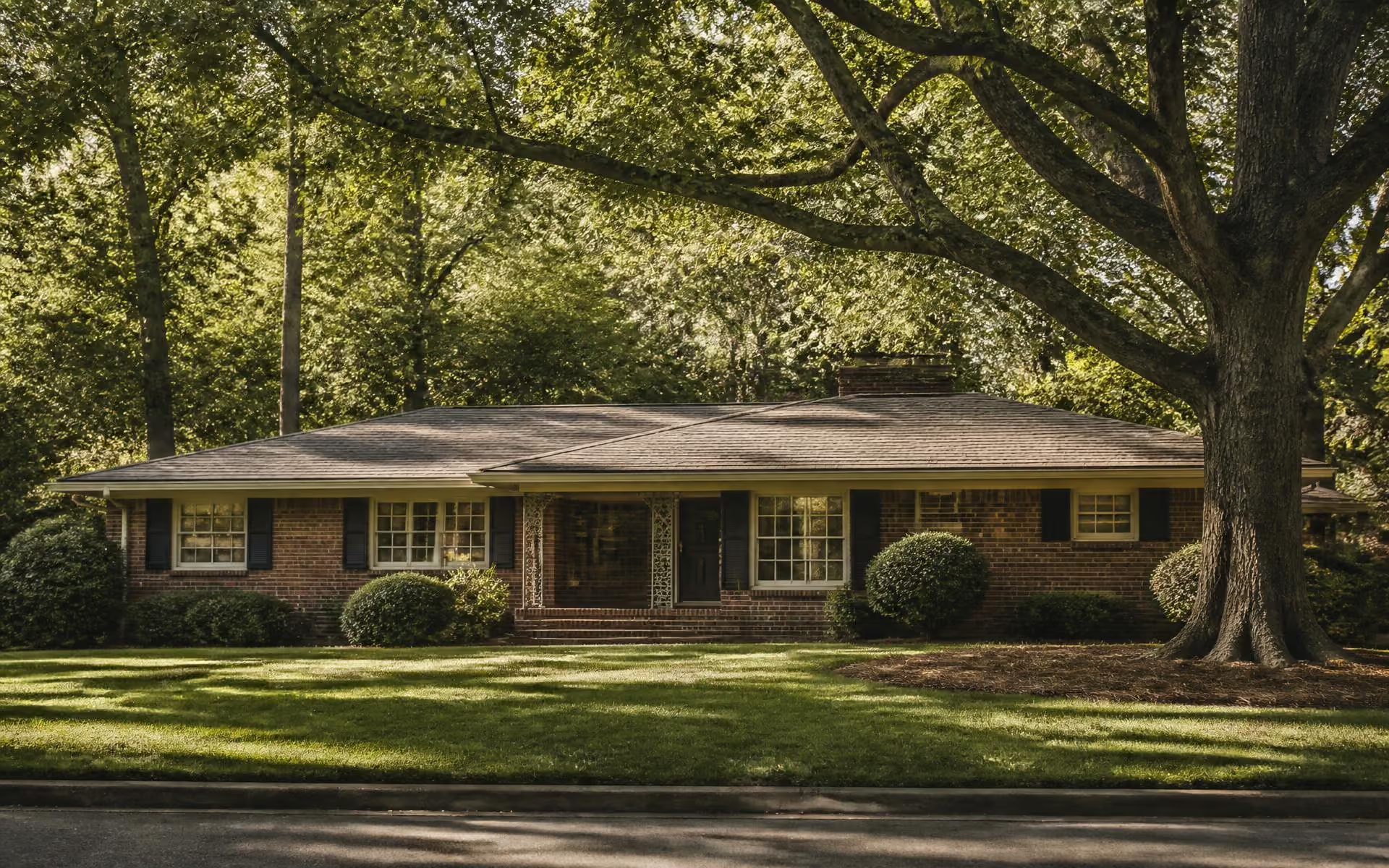
Established homes beneath mature trees in Cotswold, Charlotte

The Cotswold Journal · November 2, 2026

Why the Tree Canopy Shapes Cotswold Property Value

The dense canopy of mature willow oaks overhead is often what persuades buyers to choose Cotswold, yet those same seventy-year-old trees represent one of the neighborhood's most significant ongoing property commitments.

The Character of the Canopy

When residential streets through the Cotswold neighborhood were platted in the nineteen-fifties, developers left or planted thousands of native hardwoods across generous half-acre lots. Willow oaks dominated these plantings, chosen for rapid growth and broad summer shade. Seventy years later, their interlocking branches create a continuous vaulted ceiling over residential streets between Randolph Road and Sharon Amity Road. This mature canopy immediately signals established character, contrasting sharply with the bare streetscapes common to newer subdivisions further down the southern corridor.

That green ceiling carries tangible financial weight in Cotswold real estate. Appraisers and buyers routinely favor streets with unbroken tree cover over blocks where clear-cutting preceded modern construction. The canopy softens the transition between original brick ranches and larger replacement homes, providing visual continuity across shifting architectural styles. A property sheltered by healthy hardwoods feels anchored to the landscape in a way that freshly planted saplings cannot replicate for several decades.

Cooling, Drainage, and Summer Shade

The functional value of these trees becomes obvious during North Carolina summers. The thermal mass of mature oaks significantly lowers ambient street temperatures, deflecting direct radiant heat from asphalt driveways and brick exterior walls. For owners of mid-century single-story homes across the 28211 ZIP code, where original attic insulation and single-pane glazing often remain partially intact, dense shade relieves substantial mechanical strain on cooling systems. The difference in utility bills between a heavily shaded Cotswold parcel and an exposed lot can be meaningful over several summer months.

Beyond temperature regulation, the root networks of mature hardwoods perform critical stormwater management. Cotswold sits near low-lying drainage basins feeding into Briar Creek, and sudden afternoon downpours can quickly overwhelm conventional guttering and street culverts. A single fully grown willow oak absorbs hundreds of gallons of water during severe rain events, stabilizing yard grading and preventing surface erosion. When owners remove trees without considering site drainage, they frequently discover new water pooling against their foundation or across neighbouring boundaries.

Navigating Lifespan and Storm Exposure

Living under seventy-year-old trees requires accepting a baseline of physical risk. Willow oaks in urban environments have an effective lifespan of eighty to one hundred years, meaning many trees across Cotswold Charlotte are approaching the final quarter of their natural life. Unlike taproot species, willow oaks develop shallow, lateral root systems that can suffer from soil compaction, trenching, and prolonged drought. When severe summer squalls or winter ice storms pass through Mecklenburg County, aged limbs or compromised root plates can fail unexpectedly.

Property damage from falling timber is not hypothetical here; it is an established part of residential life. A healthy crown can mask internal trunk decay or root rot caused by decades of landscape changes. Prospective buyers should walk the entire perimeter of a property and scan the upper canopy for dead wood, fungal conks at the base, and unbalanced lean toward rooflines. Understanding whether a specimen tree threatens your roof, service drops, or a neighbour's driveway allows you to budget realistically before closing.

Essential Questions for the Seller

During contract negotiations, prospective buyers should request detailed records of past tree care just as carefully as HVAC servicing logs. Inquire when the property last received crown thinning, deadwood removal, or deep-root fertilization. An owner who has contracted regular maintenance through a certified arborist has actively protected the asset. Conversely, years of neglected deadwood hanging directly over a master bedroom or garage ceiling indicate a deferred maintenance cost that the buyer will inherit immediately upon taking possession.

It is equally important to clarify boundary lines and ownership of mature specimens. In Cotswold, many large hardwoods sit directly on property lines or within municipal right-of-way strips along the street curb. The City of Charlotte maintains certain street trees, meaning unpermitted trimming or removal can carry steep regulatory penalties. Establishing whether a leaning oak is your responsibility, your neighbour's, or the city's determines who pays for routine pruning and who carries liability should a major branch drop during high winds.

Commissioning a Pre-Purchase Tree Assessment

Standard home inspectors look at roof shingles, electrical panels, and crawlspaces, but their reports rarely evaluate the health of towering exterior vegetation. Engaging an independent consulting arborist certified by the International Society of Arboriculture provides objective clarity during your due diligence window. An arborist assesses structural integrity, root health, and trunk hollows, offering a clear prioritized action plan for pruning, cabling, or potential removals before you commit to purchase.

Removing a failing seventy-foot oak in an established Cotswold backyard is a complex, costly operation. Cranes often cannot navigate narrow side yards or low-hanging overhead power lines along mature residential avenues, which escalates labour expenses. Factor in stump grinding, site remediation, and replacement landscaping, and the cost of managing single problem trees can run into several thousand dollars. Knowing these figures upfront prevents sudden financial surprises during your first year of homeownership.

Published November 2, 2026 by Discover Cotswold. Editorial commentary about the Cotswold area of Charlotte, North Carolina. Figures and conditions change — verify anything you intend to rely on with the responsible authority.

Common Questions

Questions this raises

How does the tree canopy affect home insurance rates in Cotswold?

Insurers in Charlotte evaluate exposure to mature trees during underwriting. If large hardwoods overhang your roofline or have visible dead limbs, underwriters may require pruning before binding coverage. While canopy shade rarely increases base premiums directly, falling branch damage is a common claim, making a clean arborist record helpful for maintaining coverage stability.

Source: City of Charlotte

Can I remove a mature oak tree on my Cotswold property?

Private property owners can generally remove trees on their deeded land without municipal permits, provided they are not within protected stream buffers or designated tree-save areas. However, trees located within the public right-of-way along residential streets belong to the City of Charlotte. Removing or severely trimming city-maintained street trees requires formal municipal approval and can incur significant fines.

Source: City of Charlotte / Mecklenburg County Code Enforcement permitting

What does an arborist inspection typically cost in 28211?

A pre-purchase consultation by a certified arborist in the 28211 area generally ranges between several hundred dollars depending on lot size and tree count. The arborist will walk the grounds, inspect mature root flares, check for internal decay, and provide written recommendations, giving buyers clear leverage and accurate cost projections during contract negotiations.

Source: Mecklenburg County POLARIS 3G parcel viewer

One neighborhood, considered in full.

Cotswold monogram
Cotswold

Charlotte · North Carolina

The definitive independent guide to Cotswold — Charlotte's most convenient established neighborhood. Real estate, schools, the Village shops, dining, parks, and daily life between Randolph Road and Monroe Road.

Local Resources

More area guides →

Website designed by Peters & Associates, Inc. Not an official publication of any Cotswold neighborhood association, HOA, municipality, property owner, shopping center, or school.

Legal

Important notice. cotswoldcharlotte.com is an independent editorial guide. It is not a homeowners association, not a community or property owners' association, and not a shopping center, brokerage, or school, and it is not affiliated with, endorsed by, sponsored by, or officially connected to any association, retailer, developer, brokerage, school district, or governmental body. All third-party names and marks belong to their owners and are used for identification and commentary only. Content is provided for general informational purposes on an "as is" basis, is researched in good faith but may contain errors or become outdated, and is not legal, tax, financial, appraisal, or real estate advice and not an offer to sell or a solicitation to buy any property. Verify all information independently with the responsible authority before relying on it. Use of this site is governed by our Terms of Use, which include a disclaimer of warranties, limitation of liability, and binding arbitration. Equal Housing Opportunity.

Advertising disclosure. This site contains paid, sponsored, affiliate, and referral relationships. The local firms named here have a material connection to this website, and visiting or contacting one of those firms may result in a commercial engagement. Compensation never buys placement in editorial rankings or the removal of accurate information. Full details in our Advertising & Affiliate Disclosure.

Separate entities. Every business named or linked on this site — including Peters Custom Homes, Peters & Associates, Emerald & Oak Design, Peters Audio Video, Peters Signature Homes, Peters Signature Travel and Charlotte Luxe Living — is a separate, independently owned and operated business with its own management, finances, contracts, records and obligations. None is a parent, subsidiary, division, agent, partner, joint venturer or alter ego of another or of this publication, and none is responsible for the acts, debts or obligations of any other. Shared surnames, individuals, design, references or links do not create a single enterprise or common business, and no individual is personally liable for any business. This website was designed by Peters & Associates, Inc.; that statement describes who built the site only and makes no representation about ownership, funding or payment. See our Separate Entities Notice.
© 2026–2026 Discover Cotswold (cotswoldcharlotte.com). All rights reserved.

Copyright is claimed in all original text, editorial analysis, photography, illustrations, maps, data compilations, page design, code, and the selection and arrangement of this site as a collective work under 17 U.S.C. §§ 101 et seq. and international treaties. Reproduction, republication, syndication, scraping, or use for training or grounding machine-learning or generative AI systems is prohibited without prior written permission; all text- and data-mining rights are expressly reserved. Brief quotation with attribution and a live link to the source page is permitted. Third-party names and marks belong to their owners. Copyright, licensing, and takedown notices: npeters@yourleaderinluxury.com.

Charlotte's Most Convenient Neighborhood